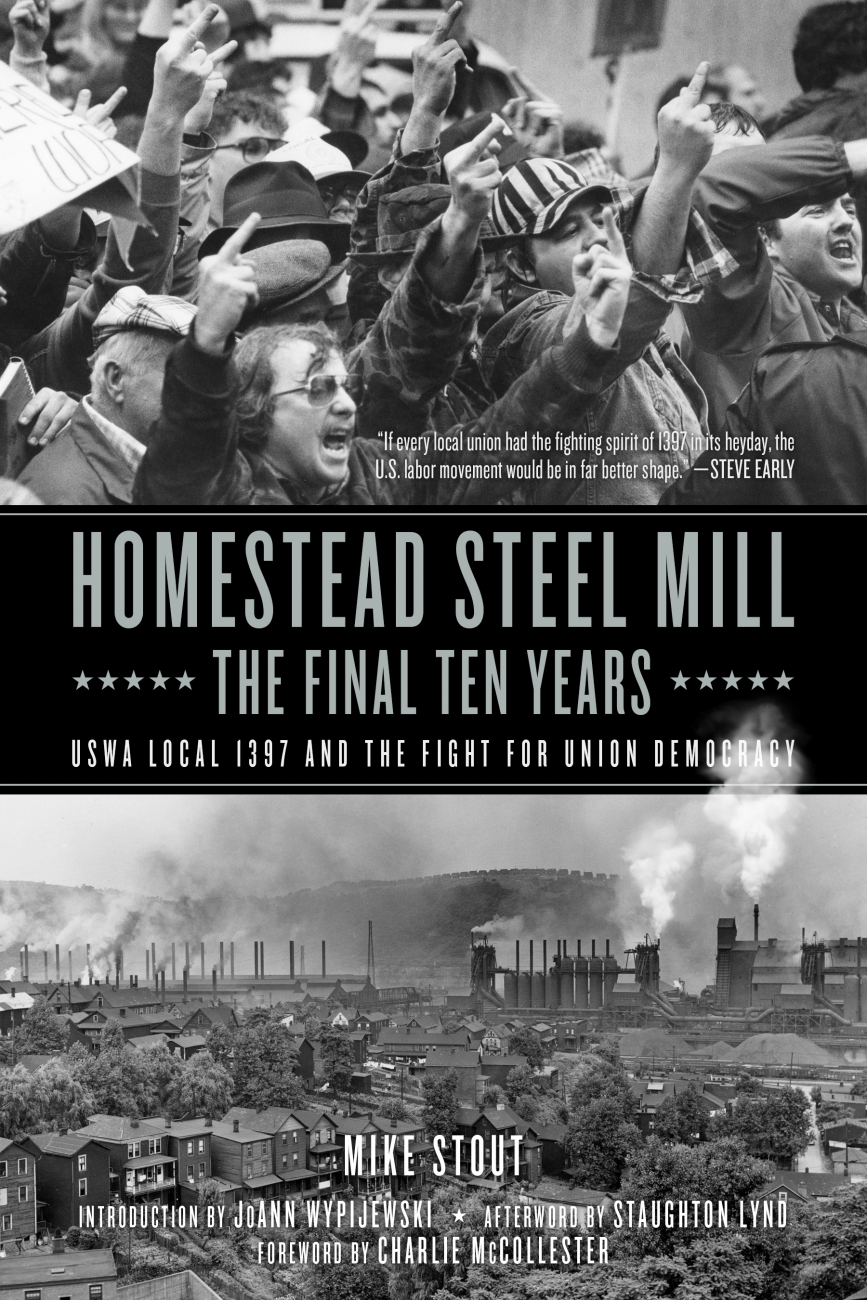
Homestead Steel Mill—the Final Ten Years: USWA Local 1397 and the Fight for Union Democracy
Please select all options before adding to cart.
Spanning the famous Homestead steel strike of 1892 through the century-long fight for a union and union democracy, Homestead Steel Mill – the Final Ten Years is a case history on the vitality of organized labor. Written by fellow worker and musician Mike Stout, the book is an insider’s portrait of the union at the U.S. Steel’s Homestead Works, specifically the workers, activists, and insurgents that made up the radically democratic Rank and File Caucus from 1977 to 1987. Developing its own “inside-outside” approach to unionism, the Rank and File Caucus drastically expanded their sphere of influence so that, in addition to fighting for their own rights as workers, they fought to prevent the closures of other steel plants, opposed U.S. imperialism in Central America, fought for civil rights, and built strategic coalitions with local environmental groups.
Mike Stout skillfully chronicles his experience in the takeover and restructuring of the union’s grievance procedure at Homestead by regular workers and put at the service of its thousands of members. Stout writes with raw honesty and pulls no punches when recounting the many foibles and setbacks he experienced along the way. The Rank and File Caucus was a profound experiment in democracy that was aided by the 1397 Rank and File newspaper—an ultimate expression of truth, democracy, and free speech that guaranteed every union member a valuable voice.
Profusely illustrated with dozens of photographs, Homestead Steel Mill—the Final Ten Years is labor history at its best, providing a vivid account of how ordinary workers can radicalize their unions.
Praise:
“Mike Stout’s well-constructed and splendidly illustrated memoir is about a special place and time, but it also serves as a window on a social insurgency that can provide inspiration for future social progress. It is a story of skilled workers who proudly got their hands dirty—an industrial world of crane men, machinists, mechanics, millwrights, laborers, and electricians that once dominated a region—but who also combined working-class culture as writers, poets musicians, cartoonists, and even lawyers. Today, there are new skills and different jobs, but class oppression endures. Greed without end or solidarity forever? The choice remains and the consequences for a sick earth and an imperial world order could not be greater.”
—Charles McCollester, chief steward, UE Local 610, Switch and Signal Plant; former professor of labor history at Indiana University of Pennsylvania
“Shop-floor activists at U.S. Steel’s famous Homestead Works played a key role in the democracy movement that swept through their national union and almost topped its top leadership in the late 1970s. After that Steel Workers Fightback campaign, they turned USW Local 1397 into a model local union, just in time to mount spirited resistance to mill closings throughout western Pennsylvania. Mike Stout’s firsthand account of rank-and-file militancy and creativity in the face of deindustrialization and capital flight contains many relevant lessons for union members today. If every local union had the fighting spirit of 1397 in its heyday, the U.S. labor movement would be in far better shape.”
—Steve Early, former International Representative, Communications Workers of America and author of Refinery Town: Big Oil, Big Money, and the Remaking of an American City
“I can see this book finding a privileged place on the shelves of American radicals. This is a labor history which is exciting, emotional, and thought-provoking, a splendid example of radical history at its best.”
—Andrej Grubacic, professor and chair of Anthropology and Social Change, CIIS–San Francisco; author of Wobblies and Zapatistas
“‘Women of Steel’ was a pretty apt name for the women working in the mills, as Mike Stout shows us. These women stood together and stood up for themselves, plus organized the guys against corporate greed and union officials’ sexism. Stout’s description of the women’s strength, smarts, and leadership comes from the heart. He worked for members’ rights alongside these women or stood behind them when they stepped forward.”
—Martha Gruelle, former coeditor of Labor Notes and coauthor of Democracy Is Power
“The best movements have the most leaders, and Mike Stout does a great job introducing us to some of the many people who took on the steel industry and devious union bureaucrats during the last decade of U.S. Steel’s Homestead Works in Pittsburgh. Mike’s union sisters and brothers built community alliances, and they had fun, partied together and mourned together. They made mistakes and built victories. It’s a story from the era of deindustrialization, but with lessons for all of us working to rebuild a powerful labor movement for the future.”
—Ken Paff, national organizer for Teamsters for a Democratic Union
About the Contributors:
For more than fifty years, Mike Stout has been an antiwar, union, and community organizer, as well as the last Local 1397 Union Grievance Chair at the U.S. Steel Homestead Works. He is currently president of the Allegheny Chapter of the Izaak Walton League, the oldest environmental conservation organization in the United States. Stout is also a singer-songwriter and recording artist, with eighteen albums and more than 150 songs written and recorded, who has used his music to raise tens of thousands of dollars for a host of social and economic justice causes.
JoAnn Wypijewski is a writer and editor based in New York. Her work has appeared in numerous magazines, including CounterPunch, where she writes a monthly column, “Diamonds and Rust.” Her latest book, with Kevin Alexander Gray and Jeffrey St. Clair, is Killing Trayvons: An Anthology of American Violence.
Staughton Lynd received a BA from Harvard, an MA and PhD from Columbia, and a JD from the University of Chicago. He taught American history at Spelman College in Atlanta. He is a lifelong union and peace activist and the author of many books, including Solidarity Unionism and Wobblies & Zapatistas.
See and hear author interviews, book reviews, and other news on Mike Stout's page HERE
See and hear more on Staughton Lynd's page HERE
Click here for one-page information sheet on this product
You May Also Like
Continental Crucible: Big Business, Workers and Unions in the Transformation of North America, Second Edition
Continental Crucible examines the clash between the corporate offensive and the forces of resistance from both a pan-continental and a class struggle perspective.
Labor Law for the Rank and Filer: Building Solidarity While Staying Clear of the Law (2nd Edition)
A guerrilla legal handbook for workers in a precarious global economy.

Living and Dying on the Factory Floor: From the Outside In and the Inside Out
David Ranney’s vivid memoir describes his work experiences between 1976 and 1982 in the factories of southeast Chicago and northwest Indiana.
SCRIP: How the Coal Companies Impoverished Harlan County
Scrip was a system designed to pay miners in pinto beans and corn meal from the company store and make billions in profits for the coal companies.
Solidarity Unionism at Starbucks
Combining history and theory Lynd and Gross make a compelling case for solidarity unionism as an effective approach to winning a voice on the job.
Strike!: 50th Anniversary Edition
Strike! narrates the dramatic story of repeated, massive, and sometimes violent revolts by ordinary working people in America. The new edition contains over a hundred pages of new materials.
Recently Viewed
Re-enchanting the World: Feminism and the Politics of the Commons
This collection centers on women and reproductive work as crucial to both economic survival and the construction of a world free from the hierarchies and divisions of capital.
New Forms of Worker Organization: The Syndicalist and Autonomist Restoration of Class Struggle Unionism
This book documents workers' struggles within an international scope. The tangible evidence here serves as a handbook for understanding the obstacles and opportunities for workers challenging neoliberal capitalism.

Parenting without God: How to Raise Moral, Ethical, and Intelligent Children, Free from Religious Dogma, Second Edition
This book is for those who lack belief in a god and who are seeking guidance on raising freethinkers and social-justice-aware children in a nation where public dialogue has been controlled by the Christian Right.

In and Out of Crisis: The Global Financial Meltdown and Left Alternatives
In and Out of Crisis stands to be the enduring critique of the crisis and an indispensable springboard for a renewed Left.