
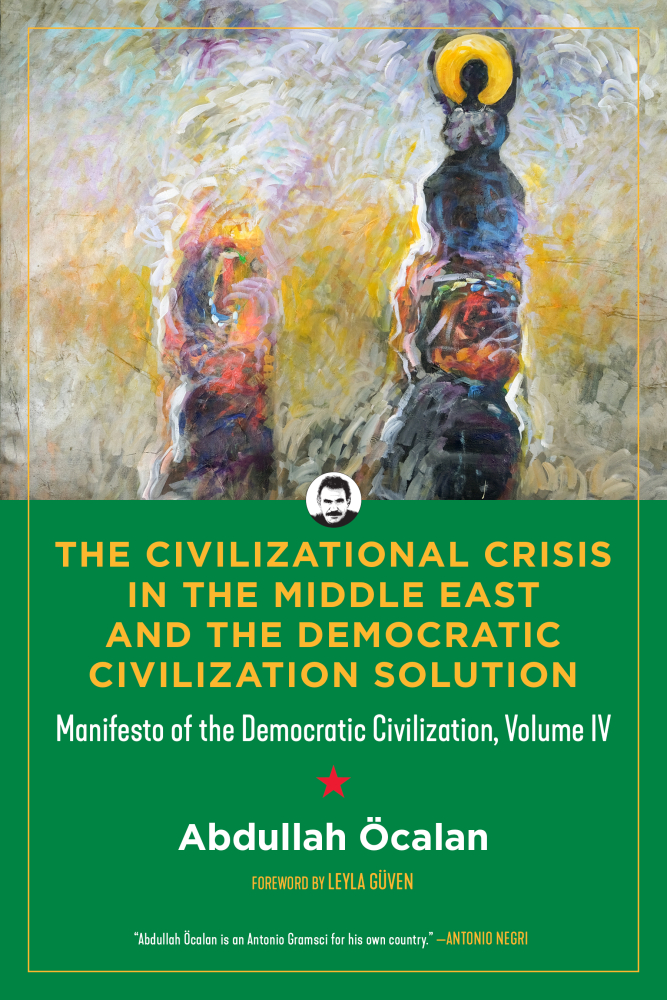
The Civilizational Crisis in the Middle East and the Democratic Civilization Solution: Manifesto of the Democratic Civilization, volume IV
Please select all options before adding to cart.
The global crisis of civilization is nowhere more visible than in the Middle East. Wars, authoritarian regimes, social fragmentation, and ecological collapse converge into a single, devastating picture. Abdullah Öcalan argues that the solution to this crisis must be found in the same place where centralized civilization first emerged 5,000 years ago.
The fourth volume of Öcalan’s Manifesto of Democratic Civilization traces the region’s deep historical crises while highlighting the many traditions of resistance—religious, cultural, communal, and antiauthoritarian—that have survived despite millennia of state domination. These traditions, he argues, provide the building blocks for a future beyond capitalist modernity.
Drawing on the theoretical framework laid out in earlier volumes, Öcalan offers a bold rereading of Middle Eastern history, revealing how patriarchy, hierarchy, and empire became entrenched, and how they can be dismantled. He presents democratic confederalism, a moral and political society, and an ecological, women-centered economic order as the essential pillars of a new civilizational model.
In this volume, Öcalan emerges not only as a strategist for resolving the Kurdish question but as a visionary for democratizing the entire region. He closes with urgent questions that speak directly to our global moment: How should we live? What must we do? And where do we begin?
Praise
“Öcalan, from his cell, reminds us that freedom is not a point of arrival, but a living process, a weaving that is remade collectively, an ethical construction that challenges us in every decision, in every word, in every step. His thought, in dialogue with the rebellious spirit of the people, becomes a vital tool for thinking about emancipation beyond classical forms of politics. That is why reading his work is not only an intellectual act, but a profoundly political act.”
—Rosario Aquím Chávez, Bolivian activist, poet, and educator
“Öcalan’s works have played a key role in inspiring one of the most widespread movements of real-life revolutionary transformation in recent memory.”
—David Graeber, author of Debt and The Dawn of Everything
“One should conclude that Abdullah Öcalan is nothing less than a Kurdish Nelson Mandela.”
—Slavoj Žižek, author of The Courage of Hopelessness
“Öcalan’s utopia—as is soon discovered—is extremely concrete; it is embodied in the struggles and the order of the zones liberated by the Kurdish communist militias! A real utopia, the one that Öcalan supports, a precious gem that strongly opposes the rebirth, so common today, of national fascisms. The utopia of the democratic confederation of peoples embodies a real process that will win every battle.”
—Antonio Negri
“In these times of accelerating climate change and deepening crises, the product of centuries of imperialism and the past few decades of hyper neoliberalism and ecological destruction, your struggle for freedom and peace has become our struggle, and your example a beacon for untold millions who will yet follow.”
—Barry Gills, professor of Global Development Studies at the Faculty of Social Sciences, University of Helsinki
About the Contributors
Abdullah Öcalan, the founder of the Kurdistan Workers’ Party (PKK), is credited with developing the paradigm of Democratic Modernity. Since his abduction in 1999, he has been imprisoned on the island of Imrali in conditions of extreme isolation. During his time in prison, he has written over ten books that have transformed Kurdish politics. Writing extensively about history, philosophy and politics, he is widely regarded as a key figure in finding a political resolution to the Kurdish question. His writings have made significant contributions to discussions on freedom and outline proposals for non-state political systems in his theories on Democratic Confederalism. His most notable work is the five-volume “Manifesto for a Democratic Civilisation”. His works have been translated into over twenty languages.
Leyla Güven is a Kurdish politician, co-chair of the Democratic Society Congress and former mayor of the municipality of Viranşehir in the Şanlıurfa Province of Southeast Anatolia of Turkey, where she represented the former Democratic Society Party.
You May Also Like
Beyond State, Power, and Violence
This book is a breathtaking reconnaissance into life without the state, an essential portrait of the PKK and the Kurdish freedom movement, and an open blueprint for leftist organizing in the twenty-first century.
Capitalism: The Age of Unmasked Gods and Naked Kings (Manifesto of the Democratic Civilization, Volume II), Second Edition
The second volume of Öcalan’s five-volume work making the convincing argument that capitalism is not a product of the last four hundred years but a continuation of classical civilization.
The Sociology of Freedom: Manifesto of the Democratic Civilization, Volume III
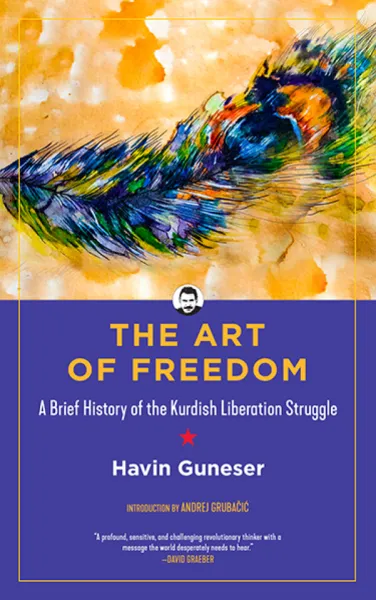
The Art of Freedom: A Brief History of the Kurdish Liberation Struggle
A vital introduction to the Kurdish struggle, this is the first English-language book to deliver a distillation of the ideas and sensibilities that gave rise to the most important political event of the twenty-first century.
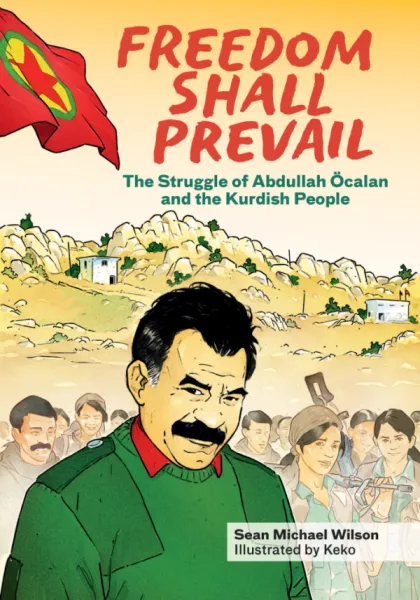
Freedom Shall Prevail: The Struggle of Abdullah Öcalan and the Kurdish People
Freedom Shall Prevail is the first graphic novel exploring the life and struggle of Abdullah Öcalan, affectionately known as “Apo.”
The State Is the Enemy: Essays on Liberation and Racial Justice
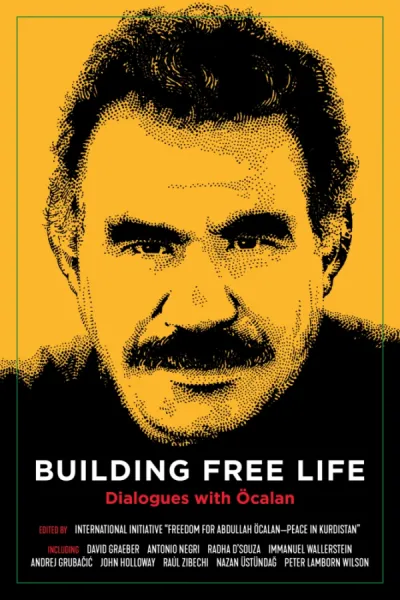
Building Free Life: Dialogues with Öcalan
Featured in this extraordinary volume are over a dozen contributors whose ideas have been investigated in Öcalan’s own writings.
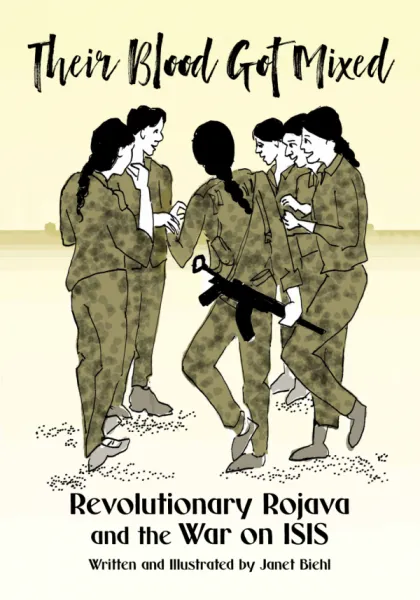
Their Blood Got Mixed: Revolutionary Rojava and the War on ISIS
An illustrated exploration of the Kurdish people's struggle, their revolution, and resistance to ISIS.
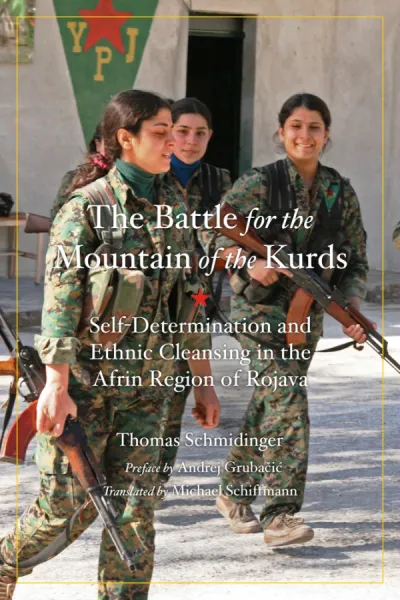
The Battle for the Mountain of the Kurds: Self-Determination and Ethnic Cleansing in the Afrin Region of Rojava
This book gives an account of the history and the present situation of the Canton of Afrin along with interviews with the inhabitants.
Recently Viewed
Be Gay, Do Crime: Everyday Acts of Queer Resistance and Rebellion
Sometimes it pays to be gay and do crime.