
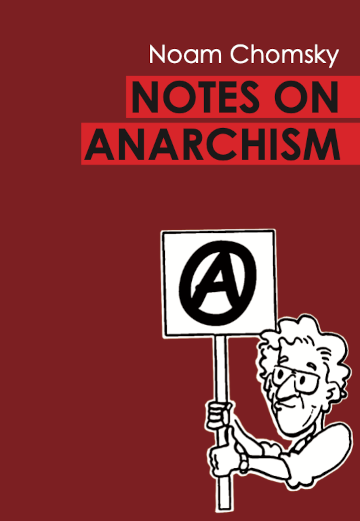
Notes On Anarchism - Chomsky (A6)
$3.50
Publisher: Active Distribution
Author: Noam Chomsky
Publisher: Active Distribution
ISBN: 9781909798281
Published: 2016
Format: Pamphlet
Size: 4.1 x 5.8
Page count: 28
A pocket-book reprint of his seminal essay first published in the 1973 collection ‘For Reasons Of State’. Decades later Chomsky proclaimed, ‘My thinking on these matters has not changed in any essential respect.’ This pamphlet provides an excellent introduction to the fundamentals and guiding principles of Anarchist ideology. It also explains the benefits of viewing Anarchism as an evolving point of view rather than a fixed dogma as well as placing the ideology in an historical context.
Keep reading
You May Also Like
Books
What Is Anarchism?: An Introduction, 2nd Ed.
Donald Rooum
This book is an introduction to the development of anarchist thought, useful not only to propagandists and proselytizers of anarchism but also to teachers and students, and to all who want to uncover the basic core of anarchism.
This book is an introduction to the development of anarchist thought, useful not only to propagandists and proselytizers of anarchism but also to teachers and students, and to all who want to uncover the basic core of anarchism.
$15.95
Options

Books
Anarchist Critique of Radical Democracy: The Impossible Argument, Second Edition
Markus Lundström
This book offers an original introduction to anarchism and explores the boundaries of democracy.
$16.95
Options
Books
About Anarchism
Nicolas Walter
Originally written in 1969 and updated for the twenty-first century, About Anarchism is an uncluttered, precise, and urgently necessary expression of practical anarchism.
Originally written in 1969 and updated for the twenty-first century, About Anarchism is an uncluttered, precise, and urgently necessary expression of practical anarchism.
$14.95
Options

Books
Mutual Aid: An Illuminated Factor of Evolution
Peter Kropotkin
Every page of this new edition of Mutual Aid has been beautifully illustrated by N.O. Bonzo and includes artwork by GATS and insightful commentary by David Graeber, Ruth Kinna, Andrej Grubacic, and Allan Antliff.
From $30.00
Options

Books
Demanding the Impossible: A History of Anarchism
Peter Marshall
Navigating the broad "river of anarchy," from Taoism to Situationism, from anarcho-syndicalists to anarcha-feminists, this volume is an authoritative and lively study of a widely misunderstood subject.
Navigating the broad "river of anarchy," from Taoism to Situationism, from anarcho-syndicalists to anarcha-feminists, this volume is an authoritative and lively study of a widely misunderstood subject.
$29.95
Options

Books
Anarchism, Anarchist Communism, and The State: Three Essays
Peter Kropotkin • Introduction: Brian Morris • Bibliographic notes: Iain McKay
This collection contextualises and contemporises three of Kropotkin’s most influential essays.
This collection contextualises and contemporises three of Kropotkin’s most influential essays.
$14.95
Options

Books
Anarchy in Action
Colin Ward
This classic text is an attempt to bridge the gap between the present reality and anarchist aspirations, “between what is and what, according to the anarchists, might be.”
This classic text is an attempt to bridge the gap between the present reality and anarchist aspirations, “between what is and what, according to the anarchists, might be.”
$17.95
Options

Books
The Impossible Community: Realizing Communitarian Anarchism, Second Edition
John P. Clark
This book offers a fresh and highly readable reformulation of anarchist social and political theory to develop a communitarian anarchist solution.
This book offers a fresh and highly readable reformulation of anarchist social and political theory to develop a communitarian anarchist solution.
$24.95
Options

Books
Anarchists Never Surrender: Essays, Polemics, and Correspondence on Anarchism, 1908–1938
Victor Serge · Edited by Mitchell Abidor
Anarchists Never Surrender anthologizes Serge’s previously unavailable texts on anarchism and fleshes out the portrait of this brilliant writer and thinker.
Anarchists Never Surrender anthologizes Serge’s previously unavailable texts on anarchism and fleshes out the portrait of this brilliant writer and thinker.
$20.00
Options